
What You'll Find Inside
Ready to see how AI is shaking up the world of finance? This guide dives deep into invoice automation. You'll learn how smart software is making financial tasks way smoother, boosting efficiency, and helping businesses really take off. We'll walk you through everything you need to know, from how the tech actually works to the real-world wins you can expect for your company. Here’s a peek at what we’ll cover:
- How AI actually handles invoices.
- The big wins and perks you get.
- What to think about before you jump in.
- Figuring out if it’s worth the investment.
- What’s next on the horizon?
Introduction
This comprehensive guide delves into the transformative power of AI invoice automation and its profound impact on financial workflows. We explore how businesses are achieving unparalleled operational efficiency by integrating intelligent software solutions into their accounts payable processes. This resource is meticulously crafted for business owners, IT managers, and finance professionals seeking to understand and implement cutting-edge technologies that drive tangible results. Our aim is to provide the most exhaustive examination of AI invoice automation available, demystifying the technology and offering actionable insights.
In today's competitive landscape, manual invoice processing presents significant challenges, including costly errors and delayed payment cycles. AI invoice automation emerges as a critical solution, offering a pathway to streamline operations, reduce expenditure, and enhance financial agility. The market is witnessing substantial growth, driven by the clear advantages these systems provide. For instance, studies indicate that while manual processing can cost between $5 to $30 per invoice, automation can reduce this to under $5 (Source: Bill.com). This guide illuminates the core AI algorithms, integration strategies, and ROI frameworks essential for successful adoption, positioning it as the definitive resource for unlocking operational efficiency through AI-powered financial workflows.
Chapter: How AI Automates Invoice Processing and Transforms Financial Workflows
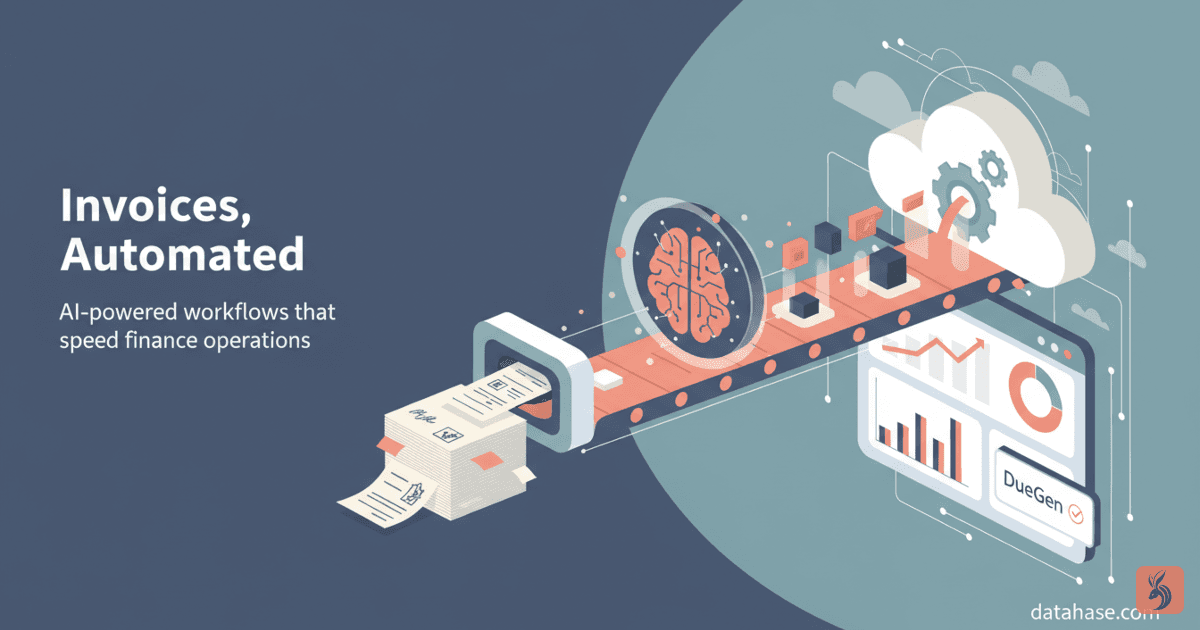
Invoice automation, particularly when enhanced with Artificial Intelligence (AI), is fundamentally reshaping financial workflows by significantly boosting operational efficiency. Businesses are increasingly adopting these solutions to combat the inherent inefficiencies and errors of manual processing, thereby accelerating payment cycles and improving overall cash flow management. The core of AI invoice automation lies in its sophisticated ability to intelligently extract data from invoices, categorize expenses with precision, and integrate seamlessly with existing accounting and ERP systems. This drastically reduces the need for manual human intervention, which not only saves substantial time and labor costs but also minimizes the risk of costly financial discrepancies.
The Mechanics of AI in Invoice Processing
AI invoice automation employs several key technologies to achieve its efficiency gains. At its foundation is Optical Character Recognition (OCR), which has evolved significantly thanks to AI. Modern AI-powered OCR can now extract text and data from scanned invoices with remarkable accuracy, even from documents with varied formats, poor image quality, or complex layouts. Following data extraction, machine learning (ML) algorithms come into play. These algorithms are trained to validate the extracted data against predefined business rules, purchase orders, and historical transaction data, ensuring a high degree of accuracy. This validation step is crucial for preventing errors before they enter the financial system. For instance, if an invoice amount does not match the corresponding purchase order, the ML model can flag it for review.
Beyond validation, AI excels at intelligent categorization. ML models learn to classify expenses, assign them to the correct general ledger accounts, or allocate them to specific cost centers based on invoice content and historical patterns. This capability transforms what was once a tedious manual task into an automated process. Furthermore, AI enables automated approval workflows. Based on the validated and categorized data, invoices can be automatically routed to the appropriate approvers according to established business rules or AI-driven analysis of spending patterns. This ensures that invoices are processed and approved promptly, avoiding payment delays. Finally, the processed data is seamlessly integrated into the company's accounting or Enterprise Resource Planning (ERP) system, creating a unified and accurate record for financial reporting and payment execution.
AI's Role in Continuous Improvement and Learning
A significant advantage of AI in invoice automation is its capacity for continuous learning. Unlike traditional rule-based systems, AI models improve over time. With each invoice processed, the ML algorithms refine their understanding of invoice structures, vendor specifics, and data patterns. This means that the accuracy of data extraction, validation, and categorization steadily increases, reducing the need for manual exceptions and corrections. This ongoing enhancement allows businesses to not only streamline their current financial workflows but also to adapt to evolving invoice formats and business requirements with greater ease. This self-improvement aspect is what truly differentiates AI-powered solutions, ensuring sustained operational efficiency and a reduced total cost of ownership over the long term.
Featured Snippet: How Does AI Automate Invoice Processing?
- Data Capture: AI-powered OCR extracts text and data from scanned invoices, even with varied formats.
- Data Validation: Machine learning algorithms verify extracted data against predefined rules, purchase orders, and historical data to ensure accuracy.
- Intelligent Categorization: AI classifies expenses and assigns them to the correct accounts or cost centers.
- Automated Approval: Workflows route invoices to the appropriate approvers based on AI-driven analysis and business rules.
- Integration: Processed data is seamlessly integrated into accounting or ERP systems for payment and record-keeping.
- Continuous Learning: AI models learn from each transaction, improving accuracy and efficiency over time.
By understanding these mechanisms, businesses can better appreciate how AI invoice automation empowers them to achieve enhanced operational efficiency and transform their financial operations from a cost center into a strategic asset, as highlighted by advancements in areas like AI in Finance Transformation (Source: KPMG).
FAQ
Exploring the intricacies of AI invoice automation often brings forth numerous questions. We have compiled answers to some of the most common inquiries to provide further clarity on how these innovative software solutions enhance financial workflows and operational efficiency.
How does AI automate invoice processing?
AI automates invoice processing through a multi-stage intelligent system. Initially, advanced Optical Character Recognition (OCR) technology, powered by AI, extracts data from scanned invoices, even those with complex layouts or varied formats. Following extraction, machine learning algorithms validate this data against purchase orders, existing records, and predefined business rules, ensuring accuracy. AI then intelligently categorizes expenses, assigning them to the correct accounts or cost centers. Subsequently, automated workflows, guided by AI analysis, route invoices for approval. Finally, the validated and categorized data is seamlessly integrated into accounting or ERP systems. A key aspect is the continuous learning capability; AI models refine their performance with each transaction, improving accuracy and efficiency over time.
What are the benefits of invoice automation?
The benefits of invoice automation are substantial and directly contribute to improved operational efficiency. Key advantages include significant cost reduction per invoice, as manual processing can cost between $5 to $30 per invoice, whereas automation can bring this figure down to less than $5 (Source: Bill.com). Furthermore, it dramatically increases accuracy by minimizing human errors, speeds up processing times leading to faster payments and better cash flow management, and enhances compliance through standardized, auditable processes. AI-powered automation also provides better spend visibility and control.
How can AI improve financial workflows?
AI significantly improves financial workflows by transforming them from reactive to proactive operations. It enables finance functions to move beyond basic reporting towards predictive analytics and data-driven insights (Source: KPMG). In invoice processing, this means not only automating repetitive tasks but also identifying anomalies, predicting potential issues, and optimizing approval processes. This frees up finance professionals to focus on strategic activities rather than manual data entry and reconciliation, thereby elevating the department's contribution to business growth.
What is the difference between invoice automation and AI invoice automation?
Traditional invoice automation typically relies on rule-based systems and predefined templates for data extraction and processing. While it offers improvements over manual methods, it struggles with variations in invoice formats and requires significant manual setup and exceptions handling. AI invoice automation, conversely, incorporates machine learning and natural language processing. This allows it to learn from data, adapt to diverse invoice structures without extensive programming, extract data more accurately from unstructured documents, and even provide predictive insights. Essentially, AI adds intelligence, adaptability, and continuous improvement capabilities to standard automation.
How does invoice automation impact cash flow?
Invoice automation has a direct and positive impact on cash flow. By significantly reducing the time it takes to process and approve invoices, businesses can take advantage of early payment discounts offered by vendors, which can lead to cost savings. Conversely, it ensures that payments are made on time, preventing late fees and maintaining good vendor relationships. This improved efficiency and predictability in the accounts payable cycle contribute to more stable and manageable cash flow, allowing for better financial planning and resource allocation.
Conclusion
The integration of AI into invoice automation represents a profound advancement in financial workflow management, delivering substantial gains in operational efficiency. By intelligently automating data capture, validation, and processing, businesses can drastically reduce manual errors and accelerate payment cycles. This transformation is not merely about saving time and costs; it is about empowering finance teams to shift focus from routine tasks to strategic analysis and decision-making, driving greater business value.
The evidence is clear: AI invoice automation minimizes the cost per invoice, enhances accuracy, and improves cash flow predictability. As highlighted by insights from sources like KPMG and Bill.com, embracing these innovative software solutions is essential for organizations seeking to remain competitive and agile in today's dynamic market. The ongoing evolution of AI technologies promises even greater sophistication and benefits for financial operations.
To embark on this journey of enhanced operational efficiency, businesses should evaluate their current invoice processing challenges and explore how AI-powered solutions can address them. Consider a phased approach, starting with automating core invoice processing functions and gradually expanding to leverage AI's predictive capabilities. Discover how DataHase's innovative software products can empower your business to transform its financial workflows and achieve unparalleled operational efficiency.